
The global Wireless Healthcare Asset Management Market is transforming how hospitals and healthcare facilities monitor medical equipment, manage inventories, and improve operational efficiency. Increasing adoption of connected medical devices, real-time location systems (RTLS), and intelligent monitoring platforms is making wireless asset management an important component of modern healthcare infrastructure.
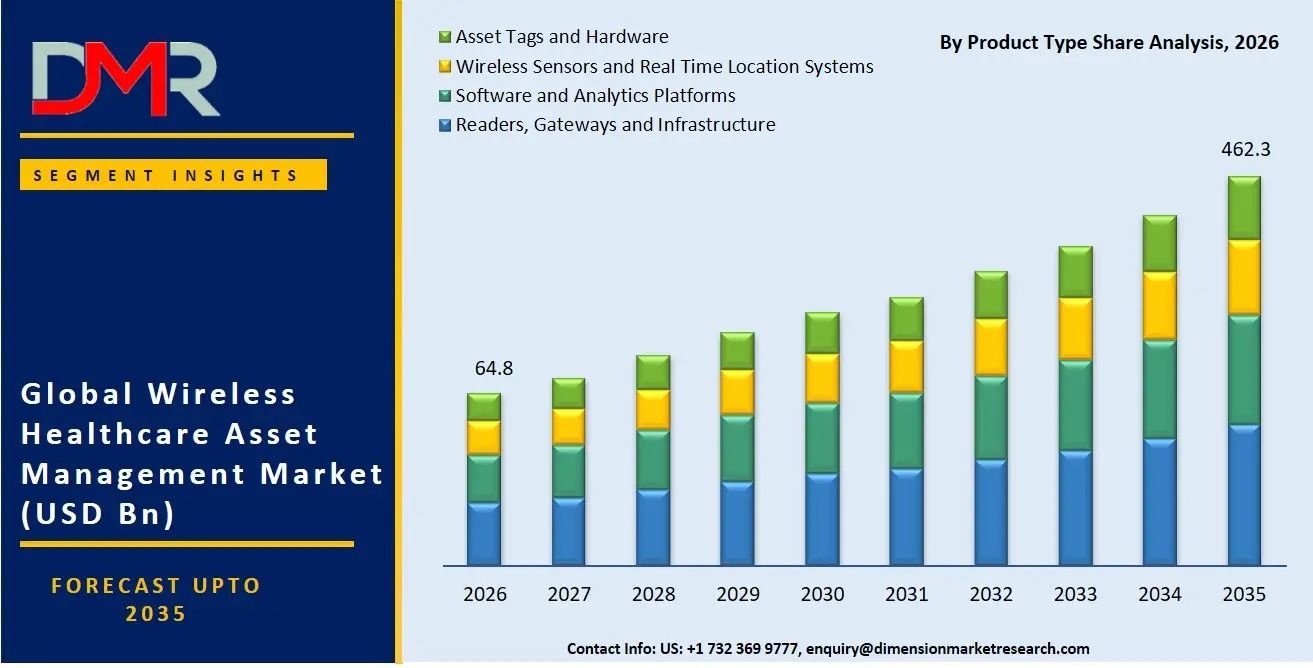
According to Dimension Market Research, the global Wireless Healthcare Asset Management Market is projected to reach USD 64.8 billion in 2026 and USD 462.3 billion by 2035, expanding at a CAGR of 24.4% during 2026 to 2035. Rising medical equipment volumes, healthcare staffing shortages, and growing investments in digital hospital infrastructure are supporting this expansion.
Healthcare organizations are increasingly transitioning from manual inventory management toward automated asset visibility platforms. These solutions help facilities locate essential equipment, monitor maintenance requirements, improve resource allocation, and reduce operational inefficiencies.
What Is the Wireless Healthcare Asset Management Market?
The Wireless Healthcare Asset Management Market includes technologies and solutions that enable healthcare organizations to identify, track, monitor, and manage physical assets through wireless communication networks.
These systems combine Radio Frequency Identification (RFID), Bluetooth Low Energy (BLE), Ultra Wideband (UWB), wireless sensors, and centralized software platforms to provide real-time information about equipment locations, operating conditions, and utilization.
Hospitals use these technologies to manage infusion pumps, ventilators, wheelchairs, diagnostic equipment, surgical instruments, and other medical assets.
Beyond location tracking, wireless platforms support preventive maintenance, inventory monitoring, environmental compliance, and workflow coordination.
Why Is the Wireless Healthcare Asset Management Market Growing?
Increasing healthcare equipment inventories are a major growth factor. Large hospitals operate substantial volumes of mobile medical devices across multiple departments, making manual monitoring increasingly difficult.
Healthcare workforce shortages are also accelerating automation. Wireless tracking systems reduce time spent locating equipment and conducting physical inventory checks, allowing clinical personnel to concentrate on patient care.
Another important driver is the growing emphasis on equipment availability, regulatory compliance, and operational cost management.
Healthcare providers are adopting connected tracking solutions to prevent equipment misplacement, reduce unnecessary rentals, and improve maintenance scheduling.
Get a Free Sample of the Wireless Healthcare Asset Management Market Report
Explore market forecasts, technology developments, competitive positioning, regional opportunities, and detailed segmentation through Dimension Market Research's comprehensive industry analysis.
https://dimensionmarketresearch.com/request-sample/wireless-healthcare-asset-management-market/
Wireless Healthcare Asset Management Market: Key Statistics
● 2026 Market Size: USD 64.8 Billion
● 2035 Market Forecast: USD 462.3 Billion
● Forecast CAGR: 24.4%
● Leading Product Segment: Asset Tags and Hardware, 42.3% share in 2026
● Leading Region: North America, 34.0% share in 2026
● Fastest-Growing Region: Asia Pacific, 27.2% CAGR
● US Market Size: USD 22.0 Billion in 2026
Market Segmentation and Technology Developments
Product Type Analysis
Asset Tags and Hardware is projected to dominate the market with a 42.3% share in 2026. These products provide the foundation for identifying and monitoring medical equipment across healthcare environments.
Wireless Sensors and Real Time Location Systems represent another important product category, accounting for approximately 28.6% of the market.
Software and Analytics Platforms are expected to experience the fastest growth as healthcare organizations increasingly seek predictive insights, centralized monitoring, and data-driven equipment management.
Technology Analysis
RFID technology is expected to maintain its leading position because of its reliability, relatively low tag costs, and established healthcare applications.
Bluetooth Low Energy is gaining adoption through energy-efficient tracking capabilities, while Ultra Wideband supports highly accurate positioning of valuable medical equipment.
Wi-Fi-based systems also benefit from existing hospital networking infrastructure, helping facilities deploy asset management capabilities with fewer additional connectivity requirements.
Application and End-User Analysis
Asset Tracking and Locating is projected to lead the application segment because equipment visibility remains a fundamental operational requirement.
Other important applications include inventory and supply chain management, environmental monitoring, staff and patient tracking, and temperature compliance.
Hospitals and Multi Specialty Centers are expected to remain the dominant end-user category, followed by adoption across ambulatory surgical centers, diagnostic facilities, and long-term care organizations.
How Artificial Intelligence Is Transforming Healthcare Asset Management
Artificial intelligence is expanding the capabilities of wireless healthcare asset management beyond basic location tracking.
AI-enabled analytics platforms can evaluate equipment movement, utilization patterns, and historical maintenance information to identify operational inefficiencies.
Predictive maintenance capabilities help biomedical engineering teams anticipate service requirements and minimize unexpected equipment failures.
Integration with hospital information systems and electronic health records can also improve coordination between equipment availability, patient demand, and clinical workflows.
Cloud-based subscription platforms are emerging as another important trend, enabling centralized asset monitoring across multiple facilities while reducing some upfront software investment requirements.
Regional Outlook: North America Leads, Asia Pacific Accelerates
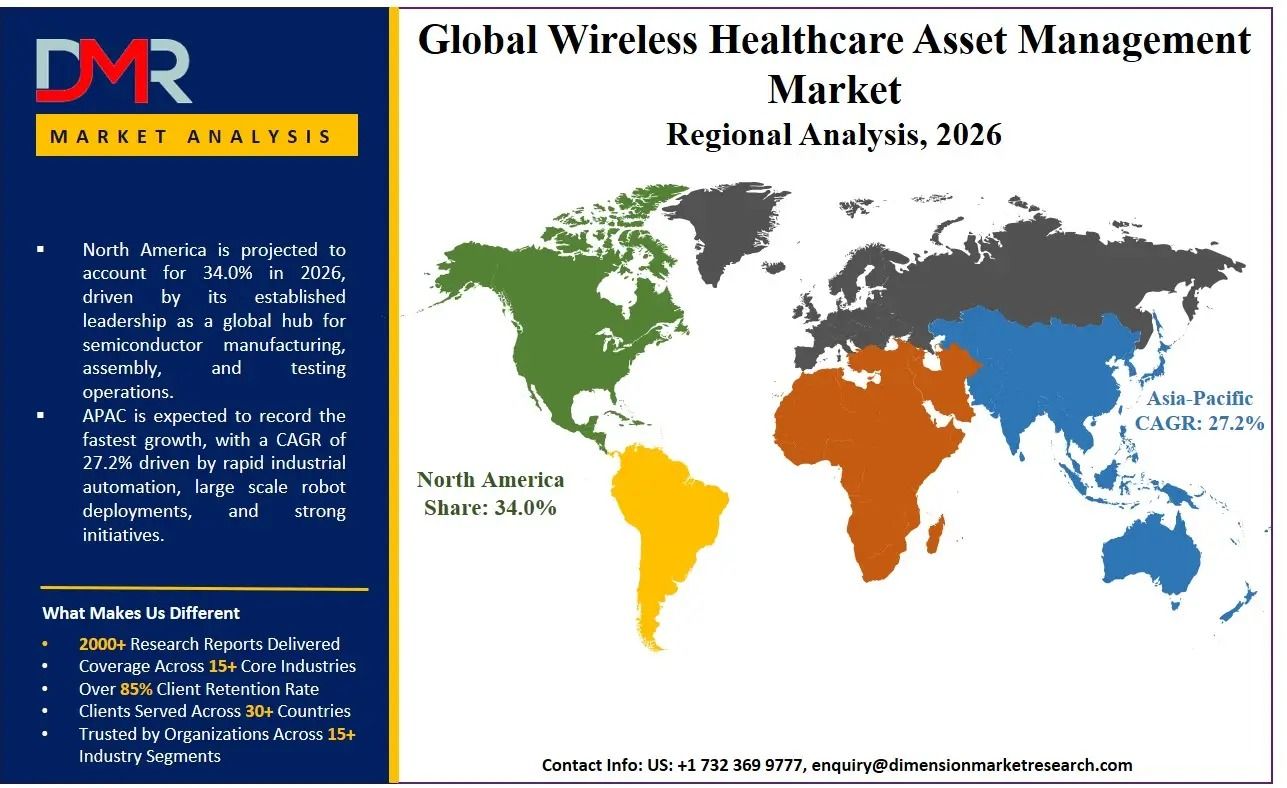
North America is projected to hold the largest regional market share at 34.0% in 2026. Its leadership reflects advanced healthcare infrastructure, widespread technology adoption, and the presence of established wireless tracking solution providers.
The United States is projected to reach USD 145.8 billion by 2035, supported by hospital network modernization and demand for efficient medical equipment management.
Asia Pacific is forecast to register the fastest regional CAGR of 27.2% through 2035.
Healthcare infrastructure expansion across China, India, and Southeast Asia, along with digital health initiatives, is creating opportunities for wireless tracking technologies.
European healthcare organizations are also adopting connected asset management systems to improve equipment traceability, operational efficiency, and compliance.
Challenges and Emerging Opportunities
Despite strong growth prospects, high initial implementation costs remain an important challenge.
Wireless asset management deployments require investments in tags, sensors, readers, gateways, software integration, and employee training.
Interoperability with existing hospital information systems can also increase deployment complexity.
However, modular cloud-based platforms and subscription pricing models are creating opportunities among medium-sized hospitals and rural healthcare facilities.
AI-powered predictive analytics and advanced asset utilization monitoring represent additional opportunities for technology providers.
Competitive Landscape
The Wireless Healthcare Asset Management Market features established technology companies, specialized RTLS providers, and emerging analytics-focused businesses.
Prominent participants include Zebra Technologies Corporation, Securitas Healthcare LLC, CenTrak Inc., GE HealthCare Technologies Inc., Cisco Systems Inc., IBM Corporation, Impinj Inc., TeleTracking Technologies Inc., Kontakt.io, and Cognosos Inc.
Competition increasingly focuses on tracking accuracy, interoperability, advanced analytics, deployment flexibility, and overall ownership costs.
Technology partnerships, product innovation, and strategic acquisitions are contributing to the evolution of integrated healthcare asset management platforms.
Explore the Complete Wireless Healthcare Asset Management Market Analysis
Dimension Market Research provides detailed coverage of market segmentation, regional forecasts, competitive developments, emerging technologies, and growth opportunities to support healthcare technology investment and strategic planning.
https://dimensionmarketresearch.com/checkout/wireless-healthcare-asset-management-market/
Frequently Asked Questions
1. What is the Wireless Healthcare Asset Management Market size in 2026?
The global market is projected to reach USD 64.8 billion in 2026.
2. What is the projected CAGR of the Wireless Healthcare Asset Management Market?
The market is expected to grow at a CAGR of 24.4% during 2026 to 2035.
3. Which segment leads the Wireless Healthcare Asset Management Market?
Asset Tags and Hardware leads the product type segment with a projected 42.3% market share in 2026.
4. Which region dominates the Wireless Healthcare Asset Management Market?
North America leads with an estimated 34.0% market share in 2026, while Asia Pacific is expected to grow fastest.
5. What is the future outlook for the Wireless Healthcare Asset Management Market?
The market is projected to reach USD 462.3 billion by 2035, supported by smart hospital adoption, AI analytics, wireless tracking, and healthcare infrastructure modernization.
Conclusion
The Wireless Healthcare Asset Management Market is becoming an increasingly important part of healthcare digital transformation. Growing medical equipment inventories, workforce limitations, and operational efficiency requirements are encouraging healthcare organizations to adopt connected asset tracking platforms.
Advancements in RFID, Bluetooth Low Energy, AI-powered analytics, and cloud-based systems are expected to expand applications across hospitals and other healthcare facilities.
As healthcare providers prioritize equipment visibility, maintenance efficiency, and technology integration, wireless asset management solutions will continue creating opportunities for healthcare technology companies and service providers through 2035.
Related Healthcare Asset Management Market Insights
Healthcare Asset Management Market Size
The global Healthcare Asset Management Market is projected to increase from USD 34.3 billion in 2025 to USD 284.7 billion by 2034, registering a CAGR of 26.5%. Growing adoption of RFID-enabled tracking, real-time location systems, and digital medical equipment management is supporting market expansion.
Hospital Asset Management Market Share
The global Hospital Asset Management Market was valued at USD 17.9 billion in 2023 and is projected to reach USD 76.1 billion by 2032, growing at a CAGR of 17.4%. North America accounted for 36.1% of market revenue in 2023, supported by advanced hospital infrastructure and asset management technology adoption.
Healthcare Technology Management Market Growth
The global Healthcare Technology Management Market is projected to grow from USD 39.7 billion in 2026 to USD 153.0 billion by 2035, registering a CAGR of 16.2%. Increasing demand for medical equipment lifecycle management, connected healthcare infrastructure, and technology-enabled maintenance services is supporting market development.