
The Trampoline Park Market is gaining momentum as families increasingly seek recreational experiences that combine entertainment, physical activity, and social interaction. According to Dimension Market Research, the global market is projected to reach USD 1,890.9 million in 2025 and grow to USD 8,153.4 million by 2034, at a compound annual growth rate (CAGR) of 17.6% during 2025 to 2034.
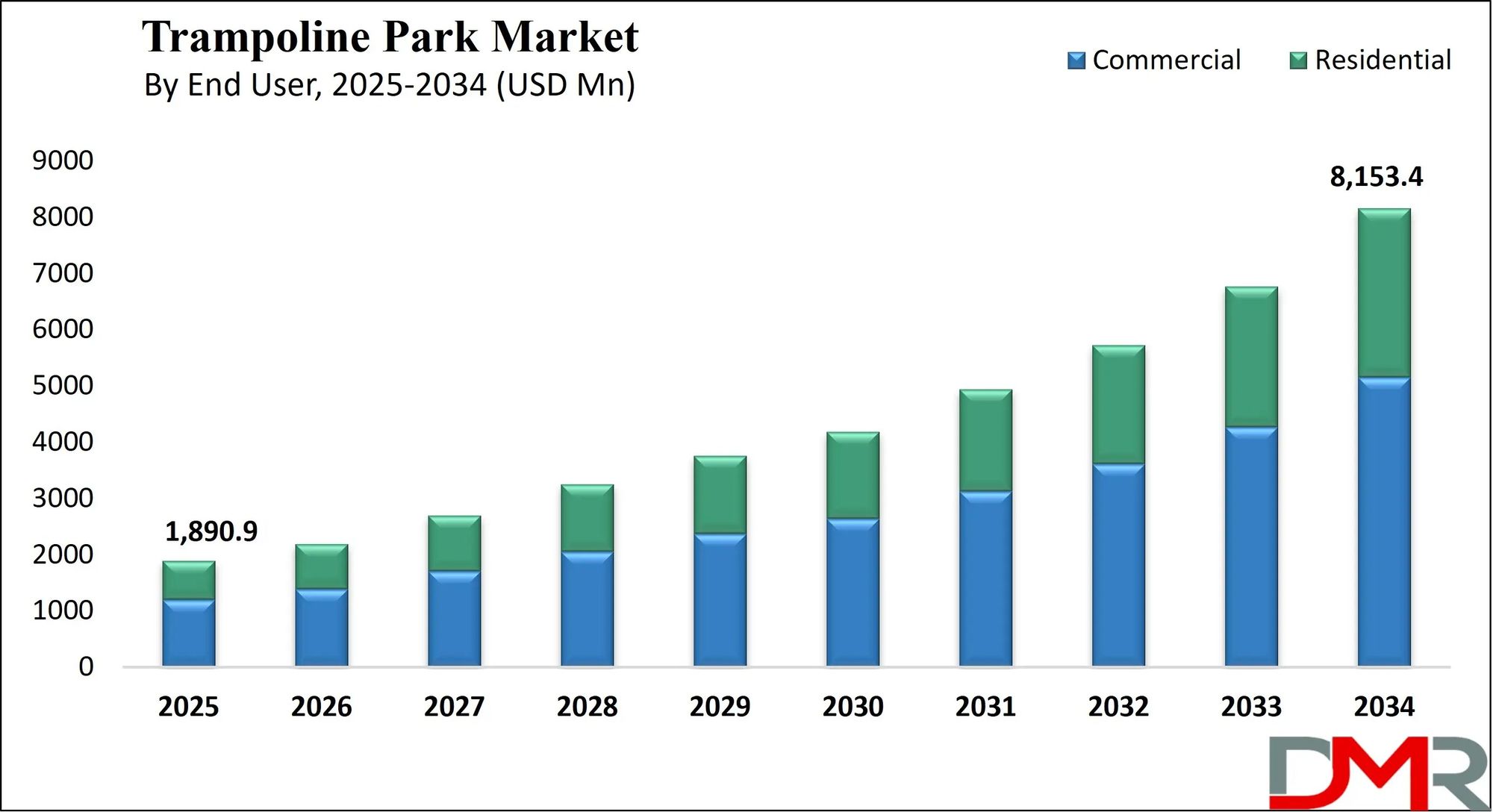
This growth reflects a broader shift in consumer preferences toward experience-based spending and organized indoor recreation. Trampoline parks are expanding beyond traditional jumping areas to offer multi-attraction environments that appeal to children, teenagers, adults, and corporate groups. Their ability to combine active play with birthday celebrations, fitness sessions, and group activities is helping broaden their commercial appeal.
As operators explore new locations, digital experiences, and diversified attractions, the industry is entering a period of significant transformation. However, sustainable growth will depend on effective safety management, operating cost control, and the ability to deliver distinctive experiences.
What Is the Trampoline Park Market?
The Trampoline Park Market comprises businesses and facilities that provide trampoline-based recreational, fitness, sporting, and related activities. These venues typically feature interconnected trampolines and may include foam pits, dodgeball courts, obstacle courses, climbing walls, and other interactive attractions.
The market serves both commercial and residential end users, although commercial facilities play a particularly important role through dedicated venues, franchise networks, and family entertainment centers. Revenue opportunities extend beyond general admission to include birthday parties, group bookings, memberships, food services, and special events.
Unlike conventional amusement venues, trampoline parks combine physical movement with social entertainment. This positioning allows operators to target several customer groups while adapting activities to different age ranges and interests.
Key Market Statistics
● 2025 Market Size: USD 1,890.9 million
● 2034 Forecast Value: USD 8,153.4 million
● Forecast CAGR, 2025 to 2034: 17.6%
● Leading Region: North America, with a projected 44.3% revenue share in 2025
● US Market Size in 2025: USD 704.5 million
Source: Dimension Market Research. Figures represent the report's estimates and projections.
Get a Free Sample of the Trampoline Park Market Report
Explore the market's growth drivers, segmentation, regional opportunities, emerging technologies, and competitive landscape to support informed business planning and investment research.
https://dimensionmarketresearch.com/request-sample/trampoline-park-market/
Why Is the Trampoline Park Market Growing?
Rising Demand for Experiential Entertainment
Consumers increasingly value memorable experiences that can be shared with family and friends. Trampoline parks respond to this demand by bringing multiple recreational activities together under one roof.
Birthday parties, weekend outings, school trips, and corporate team-building events provide several occasions for visits. Group packages and themed experiences can also help operators attract customers beyond peak weekend hours.
Greater Interest in Active Recreation
Health and fitness awareness is creating opportunities for entertainment formats that encourage movement. Trampoline parks offer recreational jumping, trampoline aerobics, fitness classes, and sports-based activities in an engaging environment.
Their appeal extends beyond children to teenagers and adults looking for alternatives to conventional leisure activities. Nevertheless, operators must communicate appropriate safety practices and ensure that activities are supervised according to their risk levels.
Urbanization and Indoor Entertainment
Urban families may have limited access to convenient outdoor recreation, while weather conditions can restrict outdoor activities. Indoor trampoline parks offer a controlled setting for year-round entertainment.
Shopping malls, commercial complexes, and repurposed industrial spaces can provide potential locations. Emerging markets, including India and other parts of Asia-Pacific, also present opportunities as organized family entertainment infrastructure develops.
Market Segmentation: Types, Applications, and End Users
Dimension Market Research segments the Trampoline Park Market across three principal dimensions.
By type, the market includes indoor and outdoor trampoline parks. Indoor facilities are projected to dominate because they can operate throughout the year and offer greater control over the environment, equipment layout, and visitor access.
By application, the categories include entertainment and leisure, fitness and training, sports and competitive activities, and therapy and rehabilitation. Entertainment and leisure is anticipated to lead, supported by family outings, birthday parties, and group activities.
By end user, the market covers commercial and residential users. Commercial facilities benefit from their ability to accommodate larger visitor volumes, organize events, and introduce additional revenue streams through food services, memberships, and complementary attractions.
These segments demonstrate how operators can differentiate their offerings according to location, target audience, and business model.
Technology and Hybrid Entertainment Are Reshaping the Industry
Technology is becoming an important tool for improving customer convenience and operational efficiency. Digital booking platforms, mobile applications, loyalty programs, and cashless payments can simplify the visitor journey while helping operators manage attendance and customer engagement.
Some emerging concepts include AI-supported operational monitoring, personalized promotions, digital activity tracking, and predictive maintenance. These applications may help businesses identify equipment maintenance needs, optimize staffing, and manage customer flow.
Another notable trend is the development of hybrid entertainment venues. By integrating climbing walls, ninja courses, interactive games, virtual reality experiences, and other attractions, operators can offer more varied experiences than trampolining alone.
The commercial value of these additions depends on their ability to attract repeat visits, improve space utilization, and generate additional spending without creating excessive operating complexity.
Regional Outlook: North America Leads, Asia-Pacific Offers Growth Potential
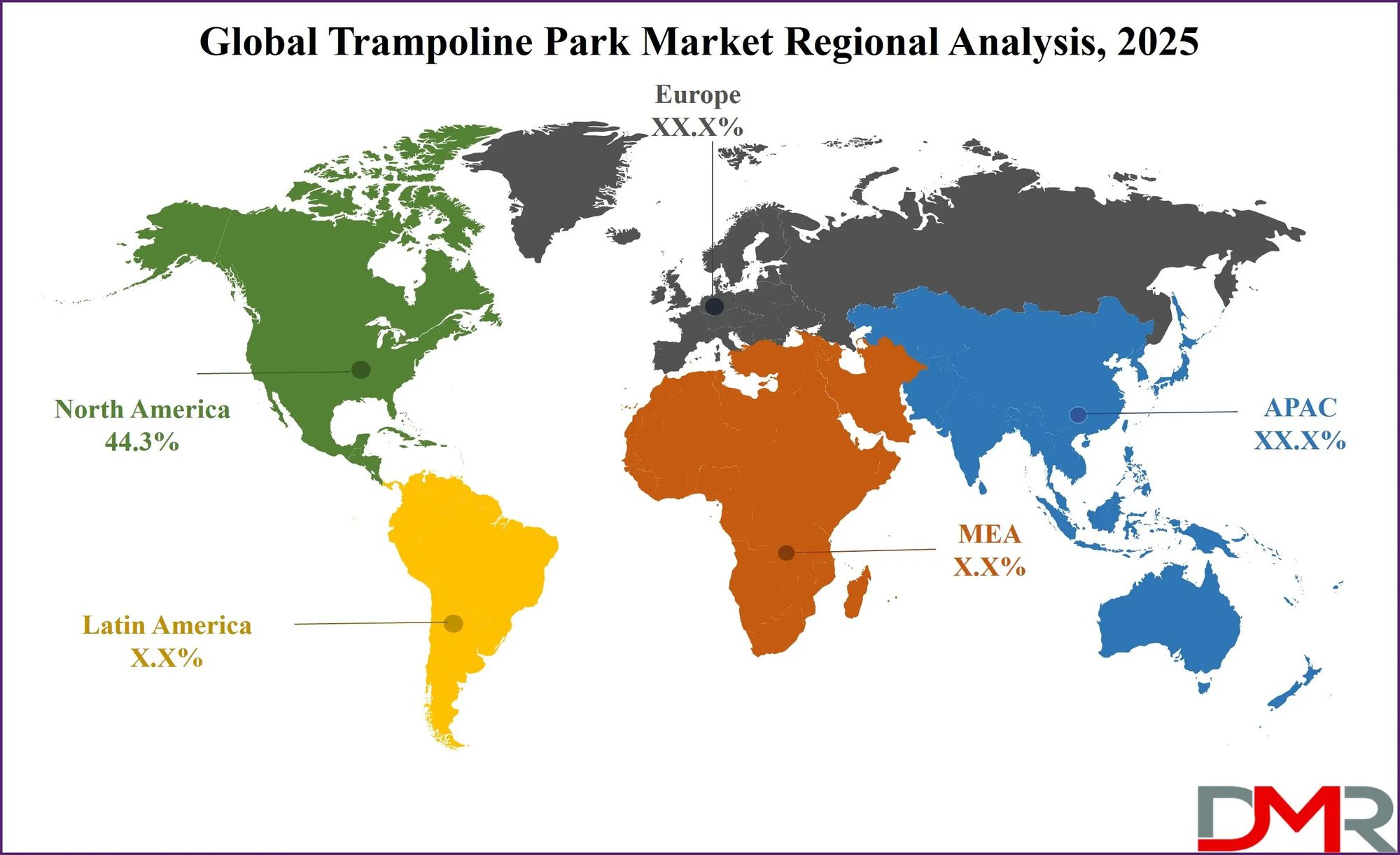
North America is projected to account for 44.3% of global trampoline park market revenue in 2025. The region benefits from an established indoor recreation industry, recognizable operators, and consumer familiarity with organized family entertainment.
The US market is projected to reach USD 704.5 million in 2025, with a CAGR of 16.5% over its forecast period. Competition in established metropolitan areas may encourage operators to differentiate through new attractions, memberships, and enhanced customer experiences.
Meanwhile, Asia-Pacific is projected to record the highest CAGR, according to the report. Urbanization, expanding middle-income populations, mall development, and rising interest in family-oriented leisure could support expansion across markets such as India, China, and Southeast Asia.
For businesses considering market entry, local consumer preferences, suitable property availability, investment requirements, and safety regulations will remain important factors in determining commercial viability.
Competitive Landscape: Differentiation Beyond Trampolines
The report identifies several prominent companies, including Sky Zone, Urban Air Adventure Park, Altitude Trampoline Park, Rockin’ Jump, Launch Trampoline Park, Flip Out, DEFY Trampoline Park, Get Air Trampoline Park, and BOUNCE Inc.
Competition is shaped by facility design, brand recognition, franchising, attraction diversity, and customer experience. Operators can distinguish themselves through group packages, fitness programs, themed activities, digital booking, and complementary attractions.
Franchise models may support expansion through established operating systems and brand awareness. However, operators must balance investment in new attractions with maintenance, staffing, insurance, and consistent safety procedures.
Challenges and Future Growth Opportunities
High initial investment remains a major barrier to entry. Real estate, specialized equipment, facility construction, staffing, insurance, and ongoing maintenance can place pressure on profitability. Safety incidents and regulatory requirements create additional operational and reputational risks.
Operators therefore need robust inspection procedures, trained personnel, clear visitor rules, and suitable emergency protocols. Effective cost management is equally important, particularly for independent facilities competing against established brands.
Looking ahead, opportunities may emerge from expansion into underserved urban markets, flexible facility formats, school partnerships, group events, and technology-enabled customer engagement. Businesses that combine differentiated entertainment with disciplined operations may be better positioned to respond to evolving consumer expectations.
Explore the Complete Trampoline Park Market Analysis
Access the full Dimension Market Research report for a deeper assessment of market segmentation, regional forecasts, competitive dynamics, growth drivers, and industry challenges.
https://dimensionmarketresearch.com/checkout/trampoline-park-market/
Frequently Asked Questions
1. What is the global Trampoline Park Market size?
The global Trampoline Park Market is projected to reach USD 1,890.9 million in 2025, according to Dimension Market Research.
2. What is the projected CAGR of the Trampoline Park Market?
The market is projected to grow at a CAGR of 17.6% from 2025 to 2034.
3. Which segment is expected to lead the Trampoline Park Market?
Indoor trampoline parks are projected to dominate by type, while entertainment and leisure is anticipated to lead by application.
4. Which region leads the Trampoline Park Market?
North America is projected to hold the largest revenue share, at 44.3% in 2025.
5. What is the future outlook for the Trampoline Park Market?
The market is projected to reach USD 8,153.4 million by 2034. Hybrid entertainment formats, digital engagement, and expansion into emerging markets are among the opportunities highlighted in the report.
Conclusion
The Trampoline Park Market is evolving from a specialized recreational category into a broader active entertainment industry. Rising demand for experiential leisure, interest in physical activity, and the expansion of multi-attraction venues are supporting its projected growth. North America currently leads, while Asia-Pacific offers opportunities for further development. Long-term success will depend on combining engaging experiences and technology with strong safety practices, operational efficiency, and a clear understanding of local demand.