
The global Personal Care Ingredients Market is undergoing a transformation as cosmetics and personal care manufacturers prioritize ingredient effectiveness, sustainability, safety, and formulation innovation. Increasing interest in naturally derived materials, advanced skincare solutions, and multifunctional ingredients is influencing purchasing and product development strategies.
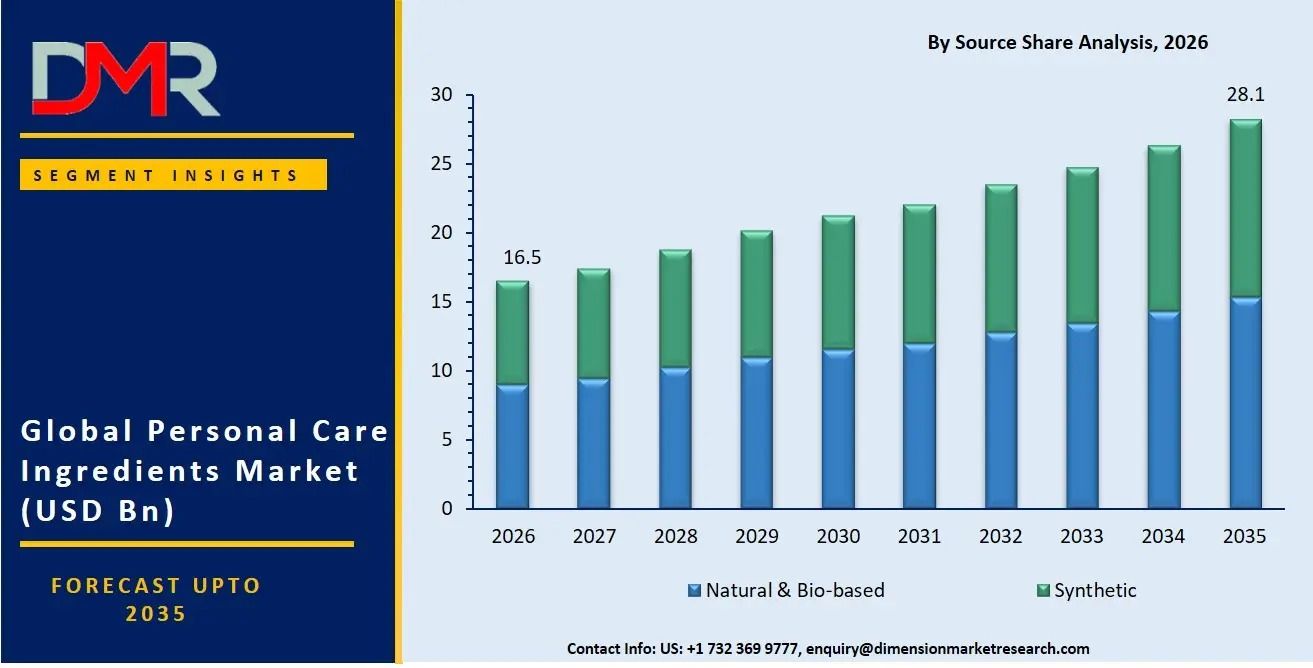
According to Dimension Market Research, the global Personal Care Ingredients Market is expected to reach USD 16.5 billion in 2026 and expand to USD 28.1 billion by 2035, registering a CAGR of 6.1%.
Demand for environmentally responsible formulations, biotechnology-derived compounds, and ingredients supporting specialized skin and haircare products is creating opportunities for suppliers.
Manufacturers are also emphasizing transparency, product performance, and responsible sourcing to address changing consumer expectations.
What Is the Personal Care Ingredients Market?
The Personal Care Ingredients Market includes chemical and biological substances used to manufacture skincare, haircare, oral care, color cosmetics, bath and shower products, and sun care formulations.
These ingredients determine important product characteristics such as cleansing performance, texture, moisture retention, stability, sensory properties, and functional effectiveness.
Major categories include emollients, surfactants, emulsifiers, humectants, conditioning polymers, preservatives, active ingredients, and rheology modifiers.
Emollients support skin softness and smoothness, while humectants help retain moisture. Surfactants contribute to cleansing, and emulsifiers help maintain stable mixtures of ingredients.
Active ingredients provide targeted formulation functions, including skin conditioning and other specialized cosmetic benefits.
Why Is the Personal Care Ingredients Market Growing?
Increasing Preference for Natural and Sustainable Ingredients
Consumer awareness of product composition and environmental impact is influencing ingredient selection.
Beauty brands are exploring botanical extracts, biodegradable surfactants, renewable feedstocks, and biotechnology-based ingredients to support sustainability objectives.
Natural and bio-based ingredients are becoming particularly important as manufacturers seek to improve product positioning while maintaining performance.
Sourcing transparency and product safety remain essential considerations, regardless of whether ingredients are naturally derived or synthetically manufactured.
Growing Demand for Advanced Skincare
Consumers are increasingly interested in skincare formulations designed for moisturizing, barrier support, sun protection, and specialized cosmetic requirements.
This trend supports demand for high-performance emollients, functional actives, humectants, and other formulation ingredients.
Premium skincare products often require specialized combinations of ingredients to deliver desirable sensory qualities and consistent performance.
Manufacturers are consequently investing in research and development to improve ingredient functionality and formulation compatibility.
Biotechnology and Digital Formulation Innovation
Biotechnology is expanding the range of ingredients available to cosmetics manufacturers.
Fermentation-derived compounds, bioengineered actives, and other specialized materials provide additional possibilities for formulation development.
Artificial intelligence-assisted formulation and digital ingredient discovery are also emerging as important market trends.
These technologies can support ingredient screening, formulation optimization, and research efficiency.
Get a Free Sample of the Personal Care Ingredients Market Report
Explore ingredient segmentation, application opportunities, regional insights, emerging biotechnology trends, and competitive developments through Dimension Market Research's industry assessment.
https://dimensionmarketresearch.com/request-sample/personal-care-ingredients-market/
Personal Care Ingredients Market Size and Key Statistics
● 2026 Market Size: USD 16.5 Billion
● 2035 Market Forecast: USD 28.1 Billion
● Forecast CAGR: 6.1%
● Leading Ingredient Type: Emollients, 22.4% share in 2026
● Leading Application: Skin Care, 38.7% share in 2026
● Leading Source: Natural and Bio-Based Ingredients, 54.2% share in 2026
● Leading Region: North America, 32.6% share in 2026
The figures highlight the importance of skincare formulations and the increasing commercial relevance of natural and bio-based ingredients.
Market Segmentation: What Is Driving Ingredient Demand?
Emollients Lead by Ingredient Type
Emollients are projected to account for 22.4% of global market revenue in 2026.
These ingredients improve skin softness, smoothness, and overall formulation sensory performance.
They are widely used in moisturizers, creams, lotions, haircare products, and other personal care applications.
Active ingredients represent an important developing category because of growing interest in functional skincare, specialized formulations, and biotechnology-derived compounds.
Skin Care Dominates Applications
Skin care products are expected to represent 38.7% of market revenue in 2026.
Demand is supported by moisturizers, sunscreens, facial treatments, anti-aging formulations, and dermatological skincare products.
Sun care is identified as a rapidly expanding application area because of increasing awareness of ultraviolet protection and innovation in protective formulations.
Haircare, oral care, color cosmetics, and bath and shower products represent additional application categories.
Natural and Bio-Based Ingredients Lead by Source
Natural and bio-based ingredients are projected to account for 54.2% of market revenue in 2026.
Botanical materials, fermentation-derived compounds, and renewable ingredient technologies are influencing formulation strategies.
Bioengineered ingredients are expected to provide growth opportunities as biotechnology enables development of specialized materials with desirable functional characteristics.
Regional Outlook: North America Leads
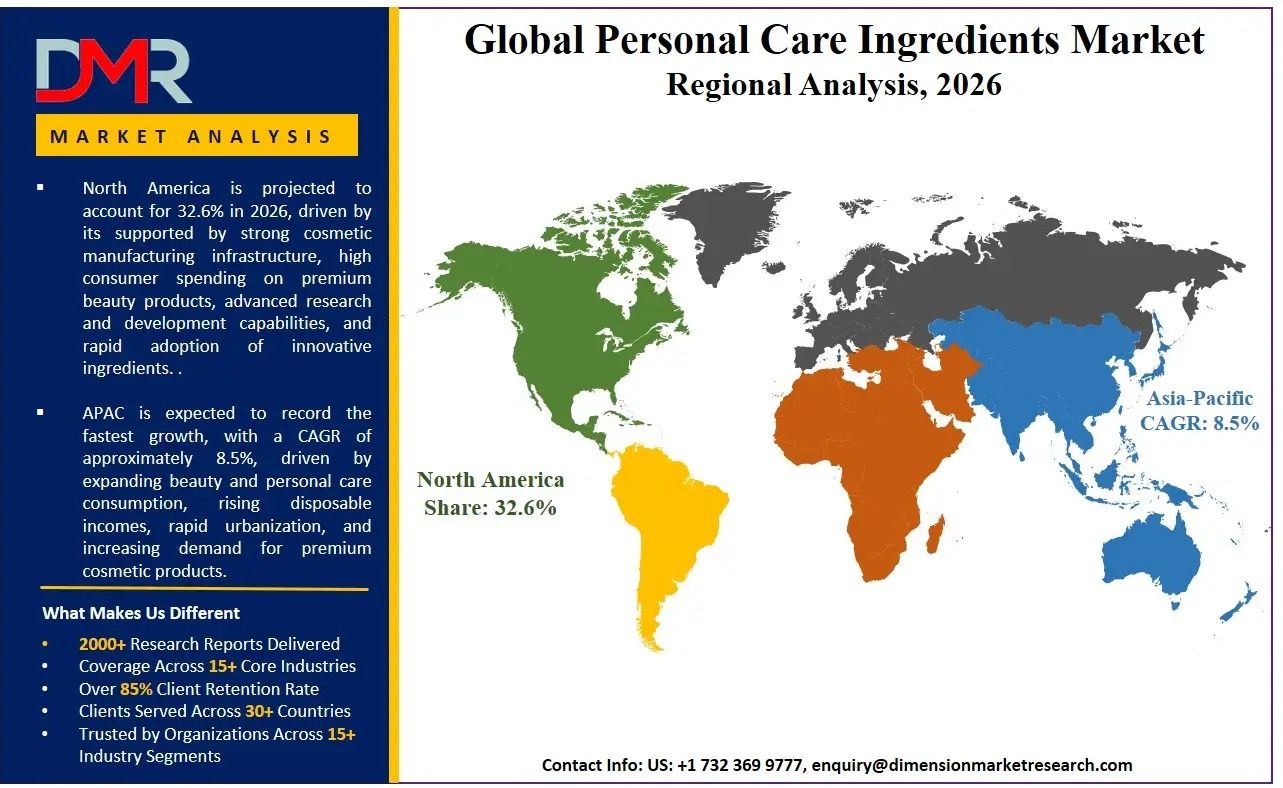
North America is projected to account for 32.6% of the global market in 2026.
The region benefits from established cosmetic manufacturing capabilities, advanced ingredient research, premium skincare demand, and investment in formulation innovation.
The United States is an important contributor through its extensive personal care industry and research infrastructure.
Europe remains significant because of regulatory requirements, sustainability initiatives, and demand for specialized cosmetic ingredients.
Asia Pacific is identified as the fastest-growing region, supported by expanding beauty consumption in China, India, Japan, South Korea, and Southeast Asian economies.
Competitive Landscape and Strategic Opportunities
Prominent companies identified in the report include BASF SE, Evonik Industries, Croda International, Ashland, Clariant, Dow, Lubrizol, Symrise, Givaudan, dsm-firmenich, and Galaxy Surfactants.
Competition increasingly focuses on ingredient performance, sustainability credentials, formulation expertise, and research capabilities.
Companies are investing in renewable raw materials, specialized active ingredients, biodegradable alternatives, and customer-specific formulation support.
For example, the report highlights BASF's April 2025 introduction of natural-based personal care ingredient solutions, including Verdessence Maize and other formulation materials.
Future growth opportunities include biotechnology-derived active ingredients, multifunctional formulations, advanced skincare applications, and sustainable ingredient manufacturing.
However, regulatory compliance, ingredient safety testing, supply chain complexity, and production costs remain important industry considerations.
Explore the Complete Personal Care Ingredients Market Analysis
Access detailed ingredient forecasts, application-level opportunities, regional analysis, biotechnology developments, and competitive benchmarking to support formulation planning, product innovation, and market expansion strategies.
https://dimensionmarketresearch.com/checkout/personal-care-ingredients-market/
Frequently Asked Questions
1. What is the Personal Care Ingredients Market size?
The market is expected to reach USD 16.5 billion in 2026 and USD 28.1 billion by 2035.
2. What is the forecast CAGR?
The Personal Care Ingredients Market is projected to grow at a CAGR of 6.1% from 2026 to 2035.
3. Which ingredient type leads the market?
Emollients are expected to lead with a 22.4% revenue share in 2026.
4. Which region dominates the market?
North America is projected to hold the largest share at 32.6% in 2026.
5. Which application accounts for the largest share?
Skin care is expected to lead with a 38.7% market share in 2026.
Conclusion
The Personal Care Ingredients Market is evolving as sustainability, biotechnology, and advanced formulation science influence the global beauty industry.
With projected revenue reaching USD 28.1 billion by 2035, opportunities are emerging across skincare actives, renewable materials, specialized emollients, and multifunctional ingredients.
Manufacturers combining research capabilities, formulation performance, and responsible sourcing are positioned to address changing market requirements.
Related Beauty and Personal Care Market Insights
Personal Care Products Market
The Personal Care Products Market Size is projected to increase from USD 431.7 billion in 2026 to USD 811.8 billion by 2035, registering a CAGR of 7.3%. The market includes skincare, haircare, oral care, hygiene, cosmetics, fragrances, and other consumer personal care products.
Vegetable Oil in Beauty and Personal Care Market
The Vegetable Oil in Beauty and Personal Care Market Share analysis examines a market valued at USD 5.77 billion in 2026 and projected to reach USD 10.43 billion by 2035, growing at a CAGR of 6.8%. Plant-derived oils are used across skincare, haircare, cosmetics, and moisturizing formulations.
Cosmetic Ingredients Market
The Cosmetic Ingredients Market Growth outlook projects global revenue to increase from USD 35.5 billion in 2024 to USD 61.2 billion by 2033 at a CAGR of 6.2%. Demand for premium beauty formulations, sustainable ingredients, and specialized cosmetic applications supports market development.