
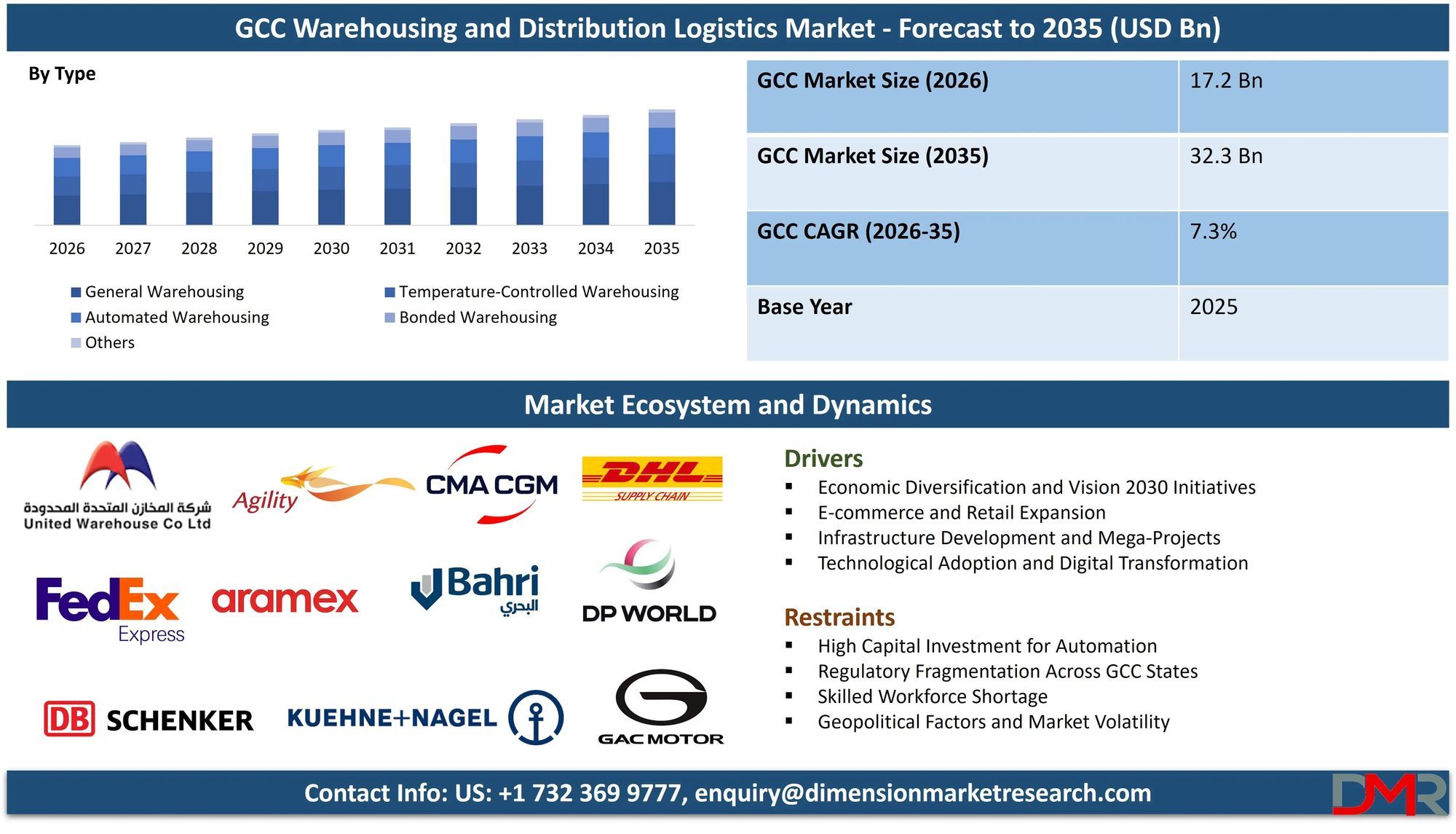
The GCC Warehousing And Distribution Logistics Market is undergoing significant transformation as Gulf economies invest in modern supply chains, automated warehousing infrastructure, and integrated distribution networks. Rising e-commerce activity, expanding industrial operations, and growing cross-border trade are reshaping how goods are stored, managed, and delivered across the region.
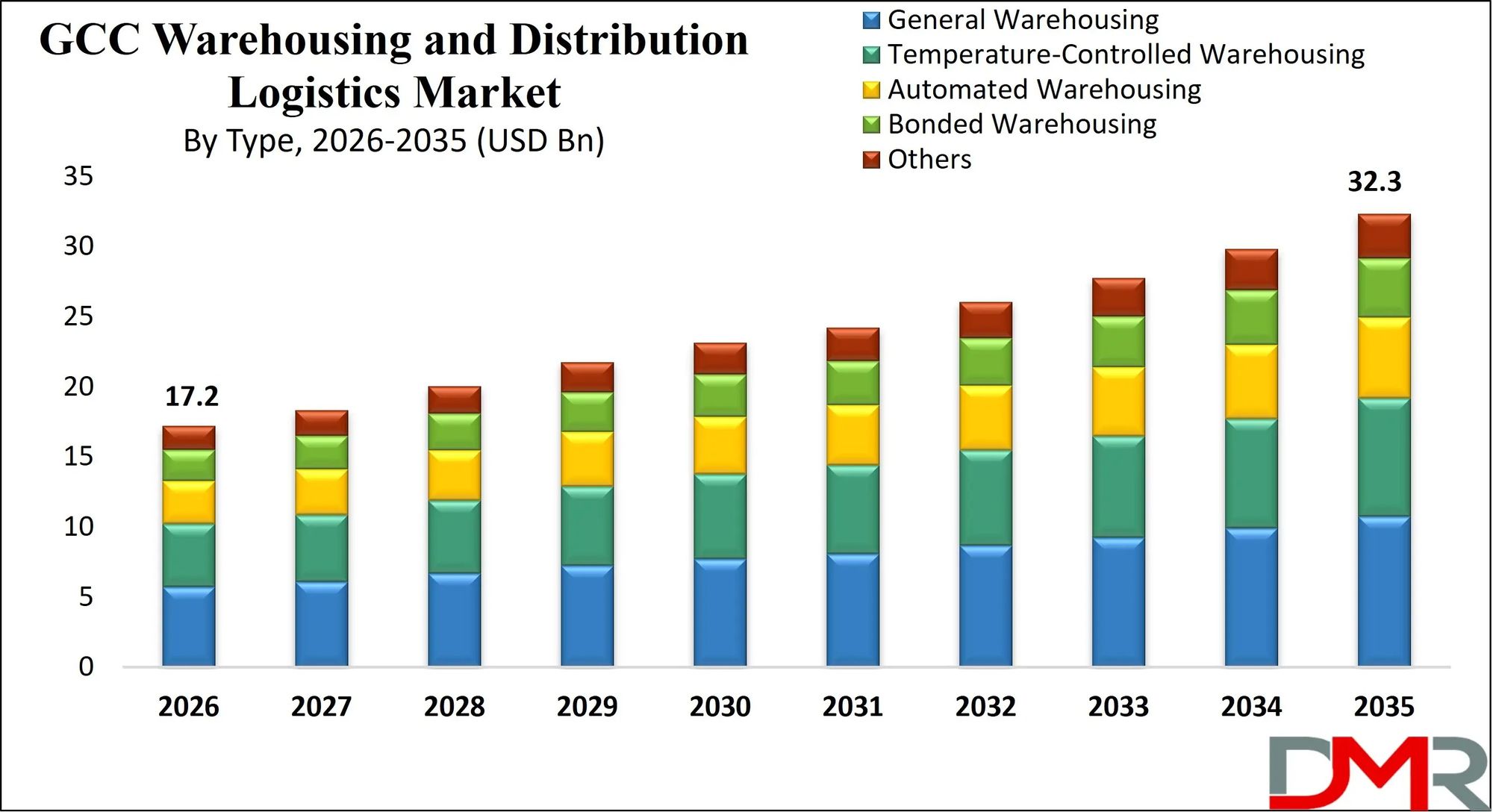
According to Dimension Market Research, the market is projected to reach USD 17.2 billion in 2026 and expand to USD 32.3 billion by 2035, registering a CAGR of 7.3% during the forecast period. Economic diversification programs, advanced logistics infrastructure, and increasing demand for efficient fulfillment services are major contributors to this expansion.
Across Saudi Arabia, the UAE, Qatar, Kuwait, Oman, and Bahrain, governments and private logistics operators are prioritizing transportation connectivity, warehouse modernization, and digitally integrated distribution systems.
What Is the GCC Warehousing And Distribution Logistics Market?
The GCC Warehousing And Distribution Logistics Market includes storage facilities, inventory management, transportation coordination, order fulfillment, packaging, and distribution services supporting regional and international supply chains.
These operations connect manufacturers, retailers, importers, exporters, and end consumers through interconnected logistics infrastructure.
Modern warehousing increasingly incorporates warehouse management systems, automated storage and retrieval systems, robotics, IoT tracking, and predictive analytics to improve inventory visibility and operational efficiency.
GCC Warehousing And Distribution Logistics Market Size and Key Statistics
The research identifies the following indicators:
● Market Size in 2026: USD 17.2 Billion
● Forecast Value by 2035: USD 32.3 Billion
● Forecast CAGR: 7.3%
● Leading Warehousing Type: General Warehousing
● Fastest-Growing Type: Temperature-Controlled Warehousing
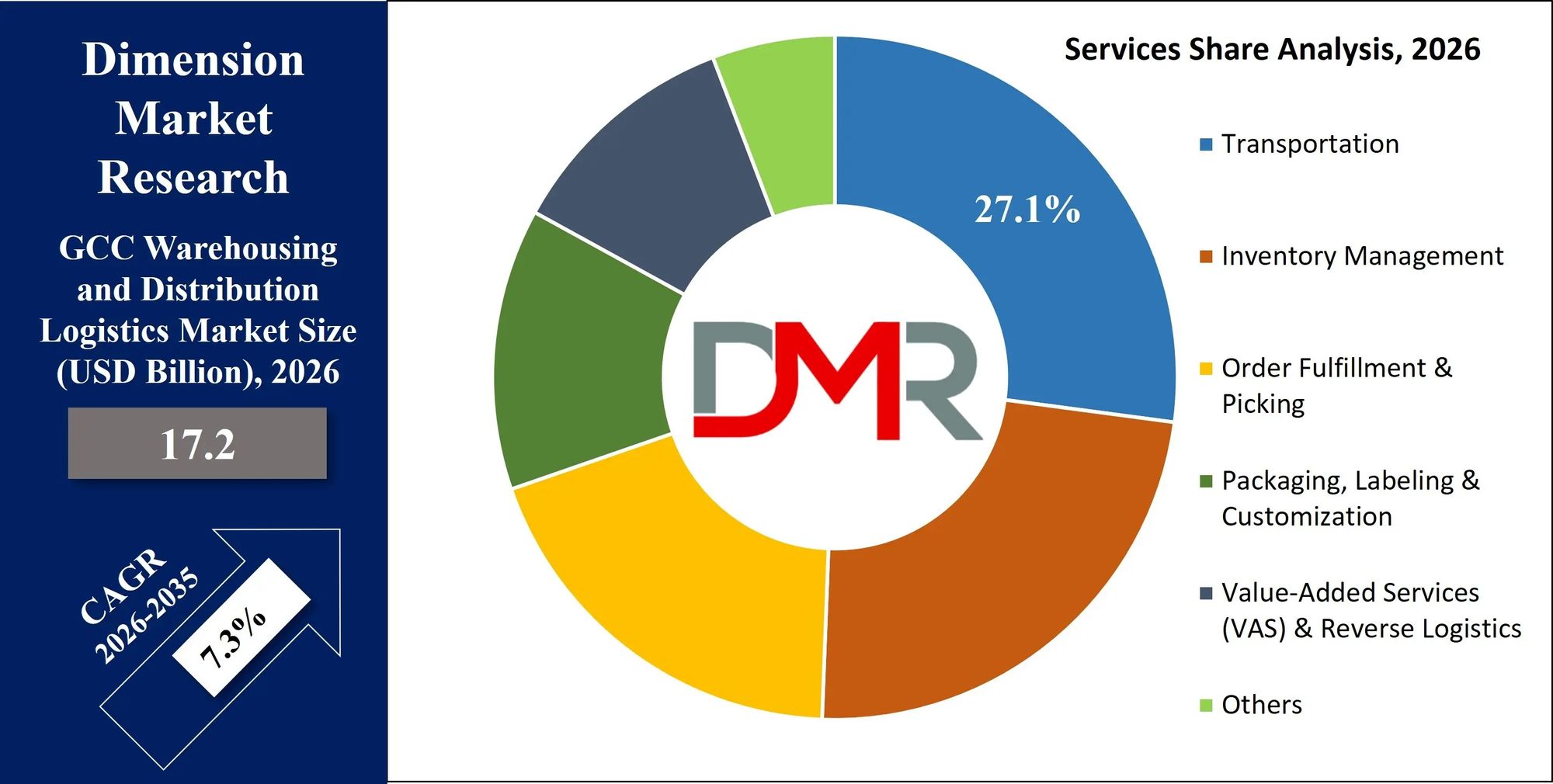
● Leading Service: Transportation
● Leading End User: Retail & E-commerce
These findings highlight the importance of general storage capacity, transportation networks, and modern fulfillment infrastructure in supporting regional logistics demand.
Get a Free Sample of the GCC Warehousing And Distribution Logistics Market Report
Explore detailed market forecasts, country-level analysis, warehouse technology adoption, competitive positioning, and emerging investment opportunities through the Dimension Market Research sample report.
Why Is the GCC Warehousing And Distribution Logistics Market Growing?
Expansion of E-Commerce and Omnichannel Retail
Increasing online shopping activity is generating demand for strategically located fulfillment centers, automated inventory systems, and efficient last-mile distribution.
Retailers are investing in modern warehousing facilities to improve order accuracy, manage product availability, and support faster delivery.
The expansion of omnichannel retail also creates demand for integrated inventory management, returns processing, and flexible distribution infrastructure.
Government Investment in Logistics Infrastructure
Economic diversification initiatives across GCC countries are supporting investments in ports, airports, rail connectivity, logistics parks, and industrial zones.
Saudi Arabia's National Industrial Development and Logistics Program and the UAE's industrial development initiatives are encouraging stronger connections between manufacturing facilities, warehouses, and transportation networks.
These investments support regional trade competitiveness and provide opportunities for third-party logistics providers.
Growing Adoption of Warehouse Automation
Logistics operators are increasingly implementing warehouse management systems, autonomous mobile robots, automated guided vehicles, and AI-enabled inventory forecasting.
Automation helps organizations improve storage utilization, reduce manual handling requirements, and support consistent fulfillment operations.
As distribution networks become more complex, technology integration is becoming an important consideration for warehouse operators.
GCC Warehousing And Distribution Logistics Market Segmentation Analysis
General Warehousing Maintains Leadership
General warehousing is projected to represent the largest warehousing type, supported by demand from retail, construction, manufacturing, and general trading businesses.
Its flexibility makes it suitable for storing diverse non-specialized products and supporting regional distribution activities.
Temperature-controlled warehousing is expected to record the fastest growth within this category. Demand is supported by pharmaceutical distribution, food imports, healthcare requirements, and the need to maintain appropriate storage conditions in the GCC climate.
Transportation Leads Service Demand
Transportation is identified as the largest service category because it connects warehouses with ports, airports, manufacturing facilities, businesses, and consumers.
Operators increasingly focus on route optimization, fleet management, multimodal connectivity, and delivery efficiency.
Inventory management represents another important service area, supported by the adoption of digital monitoring tools and warehouse management systems.
Retail and E-Commerce Dominate End-User Demand
Retail and e-commerce are expected to lead end-user demand as businesses expand fulfillment capacity and improve product distribution.
Manufacturing represents the second-largest end-user category, supported by industrial expansion and demand for reliable raw material storage and finished-goods transportation.
Regional Outlook: UAE and Saudi Arabia Drive Logistics Development
The UAE remains a major international trade and re-export hub, supported by Jebel Ali Port, Khalifa Port, free zones, and established multimodal connectivity.
Its warehousing ecosystem supports businesses distributing goods across the Middle East, Africa, and South Asia.
Saudi Arabia is expanding integrated logistics infrastructure through investments in industrial development, transportation connectivity, and dedicated logistics zones.
Qatar, Oman, Bahrain, and Kuwait are also developing port infrastructure, warehousing facilities, and distribution networks to improve trade efficiency and supply chain connectivity.
Emerging Technology Trends and Growth Opportunities
Artificial intelligence is becoming increasingly relevant to warehouse operations, particularly in inventory forecasting, robotic picking, fleet optimization, and predictive equipment maintenance.
Micro-fulfillment centers and dark stores represent another emerging trend, especially in densely populated urban areas where rapid delivery services require facilities close to consumers.
Digital twin technology is also gaining attention as logistics operators seek to simulate warehouse layouts, identify bottlenecks, and improve operational planning.
Cold-chain infrastructure offers further opportunities through increasing demand for temperature-sensitive food products, pharmaceuticals, and healthcare supplies.
However, high automation investment costs, regulatory differences, geopolitical uncertainty, and skilled workforce shortages remain important challenges.
Competitive Landscape and Strategic Developments
The GCC Warehousing And Distribution Logistics Market is moderately fragmented, with international logistics companies competing alongside established regional operators.
Prominent companies identified in the report include DHL Supply Chain, DB Schenker, Kuehne+Nagel, Agility, DP World, Aramex, Bahri Logistics, GAC, CEVA Logistics, and FedEx Express.
Competition increasingly involves integrated service portfolios, transportation coverage, warehouse capacity, digital capabilities, and specialized cold-chain operations.
The report highlights a November 2025 development involving DP World's automated temperature-controlled warehouse in Jebel Ali, reflecting growing interest in technology-enabled pharmaceutical and perishable goods logistics.
Future Outlook for GCC Warehousing and Distribution
The market's long-term development will depend on the integration of modern storage infrastructure, transportation networks, and intelligent logistics technologies.
E-commerce expansion, manufacturing growth, cross-border trade, and specialized cold-chain requirements are expected to sustain demand for advanced warehousing solutions.
Operators capable of combining digital visibility, flexible fulfillment, and efficient transportation services will be positioned to address changing regional supply chain requirements.
Explore the Complete GCC Warehousing And Distribution Logistics Market Analysis
Access the complete Dimension Market Research study for market forecasts, segmentation insights, regional opportunities, competitive benchmarking, and strategic analysis supporting logistics investments and business expansion.
https://dimensionmarketresearch.com/checkout/gcc-warehousing-and-distribution-logistics-market/
Frequently Asked Questions
1. What is the GCC Warehousing And Distribution Logistics Market size?
The market is projected to reach USD 17.2 billion in 2026 and USD 32.3 billion by 2035.
2. What is the expected CAGR of the GCC Warehousing And Distribution Logistics Market?
The market is expected to expand at a CAGR of 7.3% during 2026 to 2035.
3. Which warehousing segment leads the market?
General warehousing is projected to hold the largest share, while temperature-controlled warehousing is expected to grow the fastest.
4. Which countries are important in GCC warehousing and distribution logistics?
The UAE and Saudi Arabia are major logistics centers, supported by port infrastructure, industrial development, trade connectivity, and investments in modern distribution facilities.
5. What are the major growth opportunities through 2035?
Growth opportunities include warehouse automation, e-commerce fulfillment, cold-chain infrastructure, intelligent inventory management, and integrated multimodal logistics.
Conclusion
The GCC Warehousing And Distribution Logistics Market is entering an important phase of infrastructure modernization and technology adoption.
Growing e-commerce activity, economic diversification, industrial development, and investments in automated logistics are creating new opportunities across the region.
As businesses prioritize supply chain visibility, faster fulfillment, and operational efficiency, integrated warehousing and distribution services are expected to become increasingly important to GCC economic development through 2035.
Related Logistics and Automation Market Insights
Saudi Arabia Logistics Market Size
The Saudi Arabia Logistics Market is projected to grow from USD 55.0 billion in 2024 to USD 123.9 billion by 2033, registering a CAGR of 9.4%. Expansion is supported by infrastructure investment, supply chain modernization, international trade, and economic diversification initiatives.
South Korea Warehousing Market Share
The South Korea Warehousing Market is projected to reach USD 86.3 billion by 2033, compared with USD 47.9 billion in 2024, expanding at a CAGR of 6.8%. E-commerce development, third-party logistics services, warehouse automation, and advanced distribution infrastructure are important market growth factors.
Distribution Automation Market Growth
The global Distribution Automation Market is expected to expand from USD 21.5 billion in 2025 to USD 70.0 billion by 2034, registering a CAGR of 14.0%. This related automation market focuses on electrical distribution networks, where smart grid infrastructure, renewable energy integration, and intelligent monitoring technologies support market development.