
The Europe Dark Kitchens/Ghost Kitchens/Cloud Kitchens Market is reshaping the foodservice industry as restaurants increasingly adopt delivery-focused operating models. Rising online food ordering, changing consumer lifestyles, and demand for efficient kitchen operations are encouraging businesses to explore alternatives to traditional dine-in restaurants.
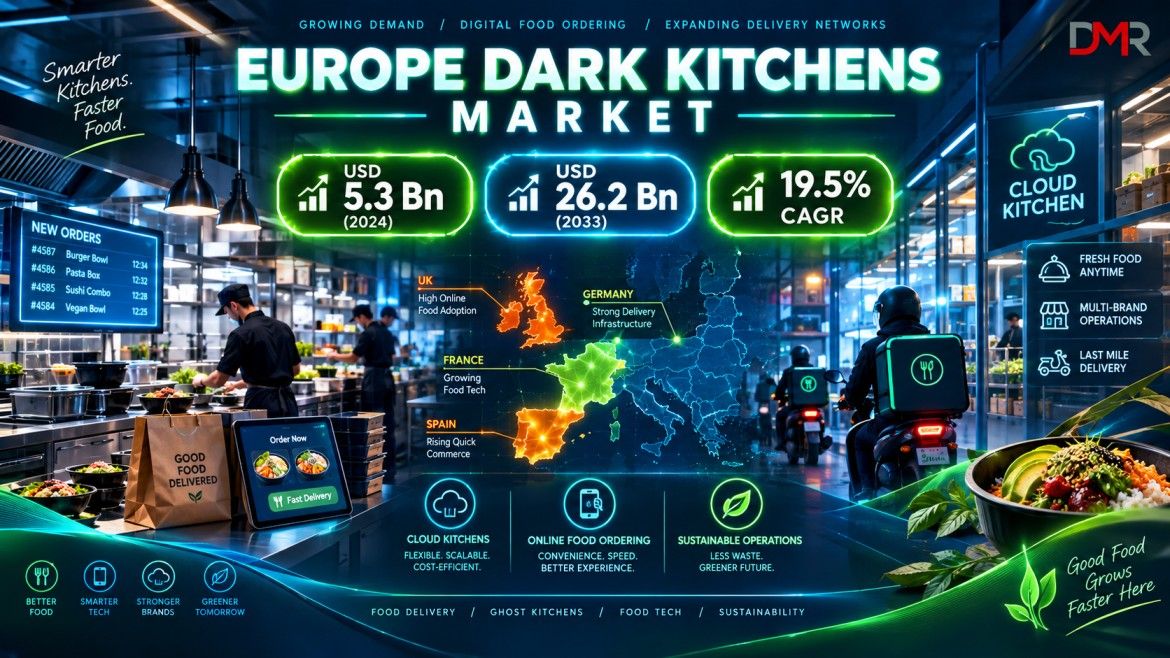
According to Dimension Market Research, the Europe Dark Kitchens/Ghost Kitchens/Cloud Kitchens Market is projected to grow from USD 5.3 billion in 2024 to USD 26.2 billion by 2033, registering a CAGR of 19.5%.
The expansion reflects a structural shift toward digitally connected food preparation facilities that prioritize delivery convenience, operational flexibility, and customer accessibility.
What Is the Europe Dark Kitchens/Ghost Kitchens/Cloud Kitchens Market?
The Europe Dark Kitchens/Ghost Kitchens/Cloud Kitchens Market includes commercial kitchen facilities designed primarily to prepare meals for delivery or takeaway without conventional dine-in services.
These businesses receive customer orders through websites, mobile applications, and food delivery platforms. Meals are prepared at dedicated production locations and delivered to customers through external or integrated logistics networks.
The business model allows restaurants and food entrepreneurs to serve multiple neighborhoods, introduce virtual food brands, and test new menu concepts without establishing full-service dining locations.
Why Are Dark Kitchens Expanding Across Europe?
Growing consumer acceptance of online food delivery is a central market driver. Digital ordering platforms have made restaurant meals more accessible while creating new opportunities for food brands to reach customers beyond traditional dining locations.
Dark kitchens eliminate the need for expensive dining areas, extensive front-of-house staffing, and certain customer-facing facilities.
This can lower entry barriers for emerging food businesses and provide established restaurant operators with a more flexible expansion strategy.
Delivery platforms such as Deliveroo and Uber Eats contribute to market development by connecting restaurants with customers through digital ordering systems.
Urbanization, changing working patterns, and the preference for convenient meal options further support the adoption of delivery-oriented foodservice models.
Europe Dark Kitchens/Ghost Kitchens/Cloud Kitchens Market Statistics
● 2024 Market Size: USD 5.3 Billion
● 2033 Forecast: USD 26.2 Billion
● Forecast CAGR: 19.5%
● Leading Business Model: Fully Equipped Kitchens
● Leading Type: Independent Cloud Kitchens
● Leading Offering: Food Delivery
● Leading Kitchen Nature: Franchised Cloud Kitchens
Get a Free Sample of the Europe Dark Kitchens/Ghost Kitchens/Cloud Kitchens Market Report
Examine European market forecasts, business models, delivery services, competitive positioning, and country-level opportunities through Dimension Market Research's comprehensive industry assessment.
Market Segmentation: Which Business Models Matter Most?
Fully equipped kitchens represent an important business model because they provide ready-to-operate facilities with cooking equipment, storage infrastructure, and sanitation systems.
These facilities enable restaurant operators to establish delivery services without making the same infrastructure investments required for traditional commercial kitchens.
Other business models include semi-equipped kitchens, bring-your-own-kitchen arrangements, kitchen-as-a-service, and order management and delivery services.
By type, independent cloud kitchens are particularly relevant because of their operational flexibility and ability to respond to local consumer preferences.
Commissary kitchens, shared facilities, kitchen pods, food trucks, and incubator kitchens represent additional operating structures.
Food delivery leads the offering segment, reflecting consumer demand for meals ordered through digital platforms.
Franchised cloud kitchens are expected to maintain a leading position by nature of kitchen, supported by established brand recognition, standardized operating procedures, and scalable business models.
How Is Technology Transforming Dark Kitchen Operations?
Digital technologies play a major role in improving the efficiency of delivery-focused kitchens.
Order management platforms help consolidate orders from multiple delivery applications. Inventory systems assist with ingredient monitoring, purchasing, and reducing operational waste.
Data analytics can help businesses understand consumer demand, identify popular menu items, and evaluate the effectiveness of promotional campaigns.
Operators can also use delivery data to evaluate kitchen locations and determine whether a particular neighborhood supports expansion.
Technology integration is therefore becoming an important competitive consideration alongside food quality, delivery reliability, and cost management.
European Country Outlook
The United Kingdom, Germany, France, and Spain are among the important markets identified in the report.
The United Kingdom benefits from an established online food delivery ecosystem, while Germany and France offer opportunities linked to urban populations and digital ordering adoption.
Spain and other European economies provide additional opportunities for delivery-only restaurant operations as consumer demand for convenience develops.
Country-level expansion depends on local purchasing behavior, delivery infrastructure, restaurant regulations, property costs, and operational economics.
Market Challenges and Competitive Landscape
Despite their cost advantages, dark kitchens face several commercial challenges.
Competition among virtual food brands can increase customer acquisition expenses. Delivery platform commissions, packaging costs, and logistical inefficiencies can also place pressure on operating margins.
Food safety requirements, hygiene regulations, and suitable commercial property availability remain critical considerations.
The competitive landscape identified by Dimension Market Research includes Uber Eats, Kitopi, Deliveroo, Kitchen United, Kitchen Hub, REEF Technology, DoorDash, and Karma Kitchen.
Businesses compete through delivery capabilities, restaurant partnerships, kitchen infrastructure, digital ordering integration, and operational efficiency.
Established restaurant brands may use dark kitchens to test new geographic markets, while specialist operators can offer shared infrastructure to smaller food businesses.
Future Growth Opportunities
The market offers opportunities in virtual restaurant development, shared kitchen infrastructure, digital order management, and specialized food delivery services.
Multi-brand kitchen operations may improve asset utilization by allowing different restaurant concepts to operate from the same facility.
Greater integration of inventory management, food preparation workflows, customer analytics, and delivery coordination could strengthen operational performance.
Success will increasingly depend on balancing delivery convenience with sustainable unit economics and consistent food quality.
Explore the Complete Europe Dark Kitchens/Ghost Kitchens/Cloud Kitchens Market Analysis
Dimension Market Research provides an assessment of business models, competitive trends, country-level dynamics, market forecasts, and opportunities influencing Europe's delivery-focused foodservice transformation.
Frequently Asked Questions
1. What is the Europe Dark Kitchens/Ghost Kitchens/Cloud Kitchens Market size?
The market is projected to grow from USD 5.3 billion in 2024 to USD 26.2 billion by 2033.
2. What is the forecast CAGR?
The market is expected to expand at a CAGR of 19.5%.
3. Which business model leads the market?
Fully equipped kitchens are expected to lead the business model segment.
4. Which European countries are important for market growth?
The United Kingdom, Germany, France, and Spain are among the important markets highlighted in the report.
5. What is driving market expansion?
Increasing online food delivery, lower front-of-house costs, digital ordering adoption, and flexible restaurant expansion strategies support growth.
Conclusion
The Europe Dark Kitchens/Ghost Kitchens/Cloud Kitchens Market is becoming an increasingly important component of modern foodservice infrastructure.
As consumers prioritize digital ordering and convenient delivery, kitchen operators that combine efficient production, strong delivery coordination, and adaptable business models are positioned to benefit from the market's long-term expansion.
Related Foodservice Market Insights
Cloud Kitchen Market Size
The global Cloud Kitchen Market was valued at USD 50.26 billion in 2024 and is projected to reach USD 130.67 billion by 2033, expanding at a CAGR of 11.2%. Growth reflects demand for delivery-focused dining, virtual restaurant concepts, and lower-overhead foodservice operations.