
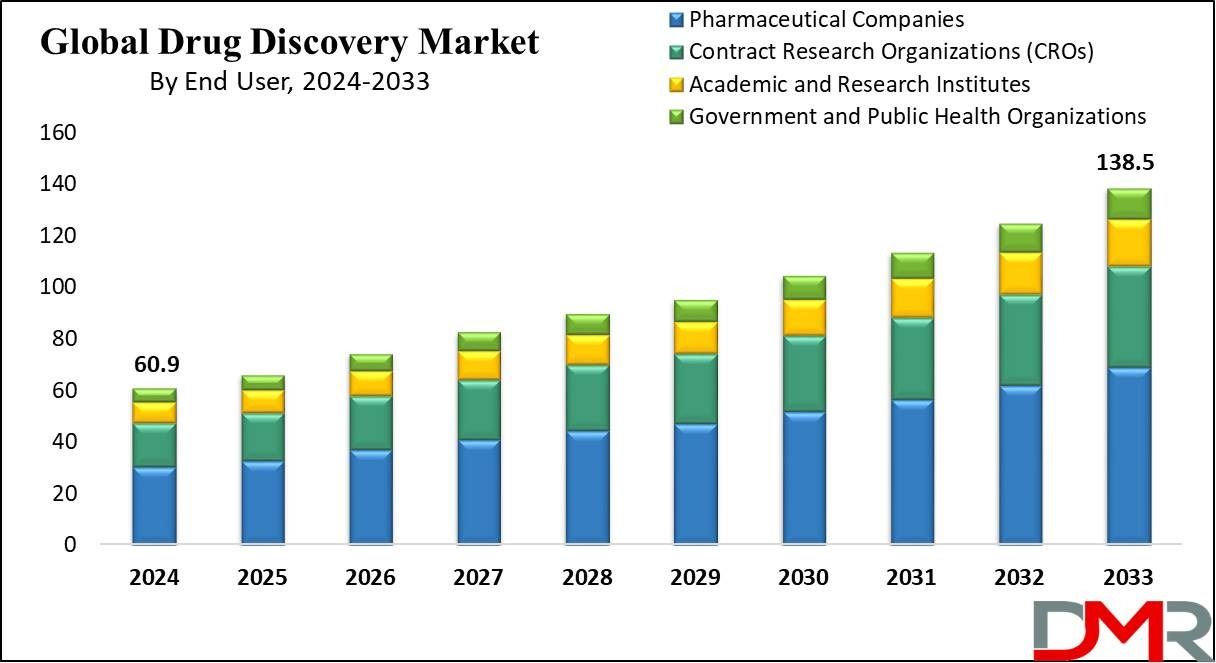
The global Drug Discovery Market is evolving as pharmaceutical companies increasingly invest in advanced screening technologies, computational research, and innovative approaches to identifying potential treatments. According to Dimension Market Research, the market was valued at USD 60.9 billion in 2024 and is projected to reach USD 138.5 billion by 2033, growing at a compound annual growth rate (CAGR) of 9.6% from 2024 to 2033. This outlook highlights the growing importance of scientific innovation and technology in pharmaceutical research and development.
Drug discovery is a critical stage in developing new medicines. It involves identifying biological targets, screening chemical compounds, evaluating promising candidates, and optimizing potential drug molecules before they advance to subsequent development stages. As scientific understanding of diseases improves, pharmaceutical companies are exploring new ways to make early-stage research more efficient and data-driven.
Artificial intelligence (AI), high-throughput screening, pharmacogenomics, nanotechnology, and gene-editing technologies are among the approaches included in the market's technology landscape. Together, these technologies offer researchers additional ways to investigate biological mechanisms, evaluate candidate compounds, and support decisions during early drug development.
What Is the Drug Discovery Market?
The Drug Discovery Market encompasses technologies, activities, and services used to identify and develop potential therapeutic compounds. It includes small molecule and large molecule drug discovery, alongside technology platforms and research activities that help scientists evaluate the suitability of drug candidates.
The market serves pharmaceutical companies, contract research organizations (CROs), academic and research institutes, and government and public health organizations. These participants contribute to different stages of discovery, from foundational scientific research to compound screening and candidate optimization.
The market's expansion reflects the continued importance of pharmaceutical innovation, investment in research infrastructure, and the adoption of more advanced discovery methods. However, drug discovery remains scientifically complex, and promising early-stage findings do not guarantee successful clinical development or regulatory approval.
Key Market Statistics
The primary DMR report provides the following verified figures:
● 2024 Market Size: USD 60.9 billion
● 2033 Forecast Value: USD 138.5 billion
● Forecast CAGR: 9.6% from 2024 to 2033
● Leading Technology Segment: High Throughput Screening (HTS), with a 24.1% share in 2024
● Leading End User: Pharmaceutical companies, with a 49.6% share in 2024
● Leading Region: North America, with a 48.9% share in 2024
These figures establish the market's reported baseline and forecast trajectory. The segment and regional shares refer specifically to 2024, rather than future-period estimates.
Why Is the Drug Discovery Market Growing?
One important growth driver is the continuing need for new treatments across a broad range of diseases. Pharmaceutical companies and research organizations invest in identifying promising therapeutic targets and developing compounds that could address unmet medical needs. Advances in molecular biology and disease research are also expanding the scientific opportunities available to drug developers.
Another important factor is the increasing use of computational tools and automation in early-stage research. Drug discovery can involve evaluating large numbers of compounds and interpreting complex biological information. Digital platforms can help researchers organize data, prioritize candidates, and conduct computational analyses before moving selected compounds into laboratory testing.
AI-based discovery methods are adding another layer to this transformation. Machine learning and other computational approaches can support target identification, molecular analysis, and candidate prioritization. Their practical value depends on data quality, experimental validation, and whether predictions translate into reproducible scientific results.
Investment in research capabilities also supports demand for specialized discovery technologies and services. Pharmaceutical companies may work with CROs, academic institutions, and technology providers to access expertise, infrastructure, and research platforms that complement their internal capabilities.
How Technology Is Transforming Drug Discovery
High-throughput screening remains an important technology within the market. It allows researchers to test large numbers of compounds against biological targets, helping identify candidates for further investigation. Its reported leadership in 2024 demonstrates its established role in the discovery process.
Pharmacogenomics provides insights into how genetic differences can influence drug response. This knowledge can support the investigation of biological variation and contribute to research into more targeted therapeutic approaches.
AI-based drug discovery is another area attracting attention. Computational systems can help analyze complex datasets, predict molecular properties, and identify relationships that may be difficult to detect using conventional methods alone. CRISPR and other gene-editing technologies can also support research into gene function and disease mechanisms.
These approaches should not be viewed as interchangeable. Each addresses different scientific questions, and their usefulness depends on the therapeutic target, research objective, available evidence, and experimental requirements.
Market Segmentation and End-User Demand
The Drug Discovery Market is segmented by drug type, technology, and end user. This structure reflects the different scientific approaches used to identify therapeutic candidates and the range of organizations involved in pharmaceutical research.
Small molecule drugs and large molecule drugs represent the two drug-type categories covered by the DMR report. Technology segmentation includes HTS, pharmacogenomics, combinatorial chemistry, nanotechnology, AI-based drug discovery, and CRISPR and gene-editing technologies.
Pharmaceutical companies accounted for 49.6% of the market's end-user share in 2024. Their established research capabilities and investments in therapeutic development make them an important customer group for discovery technologies. CROs, academic and research institutes, and government and public health organizations also contribute to market demand.
Get a Free Sample of the Drug Discovery Market Report
Explore the market estimates, segmentation, competitive environment, and forecast analysis to support your pharmaceutical market research and strategic planning.
https://dimensionmarketresearch.com/request-sample/drug-discovery-market/
Regional Outlook: North America Leads the Market
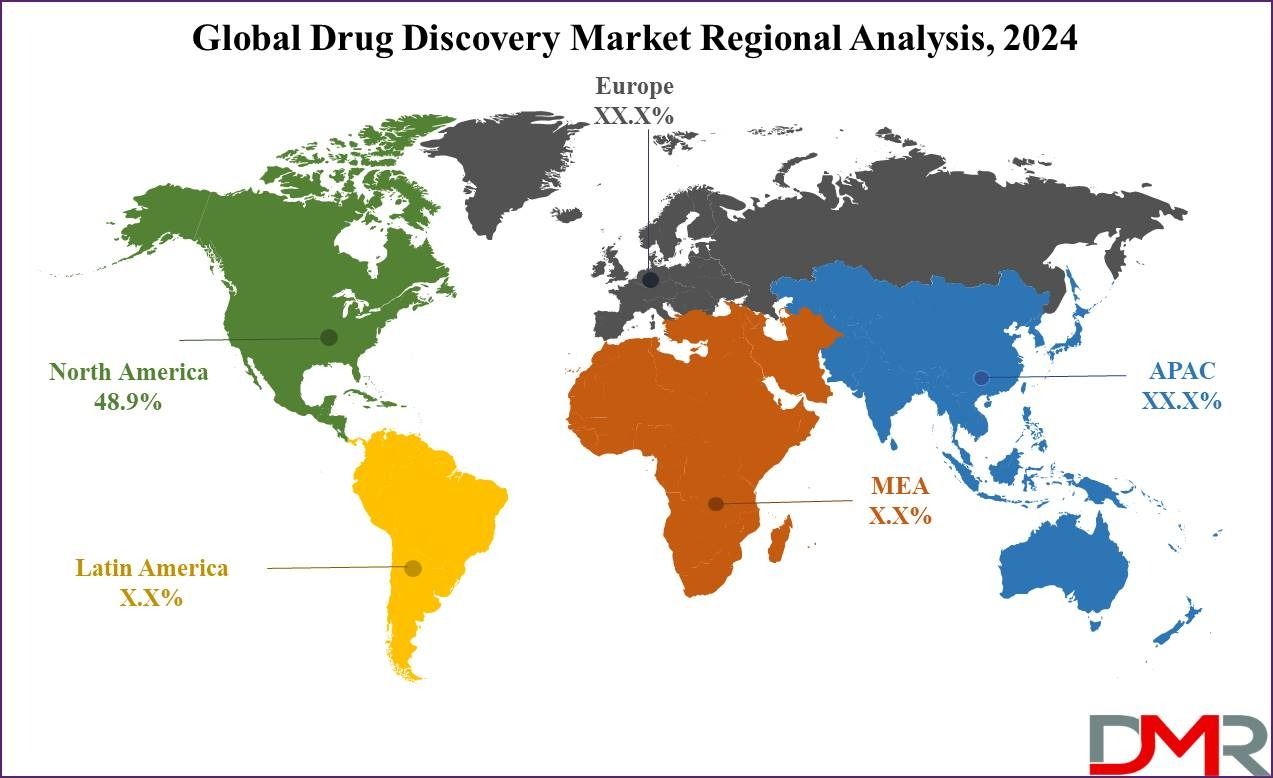
North America held approximately 48.9% of the global Drug Discovery Market in 2024, according to the DMR report. The region's established pharmaceutical research infrastructure and significant R&D activity support its leading position.
The United States is a major contributor to regional demand. The primary report estimates that the US Drug Discovery Market will grow from USD 25.0 billion in 2024 to USD 54.5 billion by 2033, representing a CAGR of 9.0% over the period.
For market participants, regional analysis can help identify where research infrastructure, pharmaceutical investment, and technology adoption are concentrated. However, regional growth opportunities should be evaluated alongside local regulations, research capabilities, and commercial requirements.
Competitive Landscape
The competitive environment includes established pharmaceutical companies and technology providers with roles in drug research, compound screening, and therapeutic development. The primary DMR report identifies Pfizer Inc., GlaxoSmithKline PLC, Merck & Co. Inc., Agilent Technologies Inc., Eli Lilly and Company, F. Hoffmann-La Roche Ltd, Bayer AG, Abbott Laboratories Inc., AstraZeneca PLC, and Shimadzu Corp among the prominent players.
Competition spans pharmaceutical research capabilities and the technologies used to support discovery workflows. Companies may differentiate themselves through scientific expertise, research platforms, screening technologies, and the ability to integrate discovery activities into broader development programs. The relative importance of these factors varies by technology, therapeutic focus, and customer requirements.
Challenges and Future Growth Opportunities
Despite its growth outlook, drug discovery involves substantial scientific uncertainty, resource requirements, and time-intensive validation. Computational predictions and laboratory screening can help prioritize candidates, but neither guarantees that a compound will demonstrate safety and efficacy in subsequent development.
Data quality, experimental reproducibility, and the suitability of discovery methods for particular biological targets remain important considerations. Organizations adopting AI-based approaches must also assess how computational findings can be validated through appropriate scientific experiments.
Looking ahead, the integration of AI, advanced screening, pharmacogenomics, and gene-editing tools provides opportunities to strengthen early-stage research. Partnerships between pharmaceutical companies, CROs, academic institutions, and technology developers may also help organizations access specialized expertise and infrastructure.
The strongest opportunities will depend on the ability to translate technological capabilities into scientifically validated results. Rather than replacing experimental research, advanced tools are likely to be most valuable when integrated into well-designed discovery workflows.
Explore the Complete Drug Discovery Market Analysis
Access the full DMR report for detailed market estimates, segment analysis, regional coverage, competitive intelligence, and forecasts through 2033.
https://dimensionmarketresearch.com/checkout/drug-discovery-market/
Frequently Asked Questions
1. What is the global Drug Discovery Market size?
The global Drug Discovery Market was valued at USD 60.9 billion in 2024 and is projected to reach USD 138.5 billion by 2033.
2. What is the projected CAGR of the Drug Discovery Market?
The market is projected to grow at a CAGR of 9.6% from 2024 to 2033.
3. Which technology segment leads the Drug Discovery Market?
High Throughput Screening (HTS) led the technology segment with a 24.1% market share in 2024.
4. Which region leads the Drug Discovery Market?
North America held the largest regional share, approximately 48.9%, in 2024.
5. What is the future outlook for the Drug Discovery Market?
The market is projected to reach USD 138.5 billion by 2033. AI-based discovery, high-throughput screening, and other advanced research technologies are among the approaches identified in the report's market outlook.
Conclusion
The Drug Discovery Market is positioned for continued expansion as pharmaceutical R&D, advanced screening, and computational technologies reshape early-stage research. With a projected market value of USD 138.5 billion by 2033, the sector offers opportunities for pharmaceutical companies, CROs, and technology providers. The long-term outlook will depend on scientific validation, effective research collaboration, and the ability to translate technological advances into viable therapeutic candidates.
Related Drug Discovery Market Insights
Drug Discovery Informatics Market Size
The Drug Discovery Informatics Market covers computational tools, bioinformatics platforms, molecular modeling, and AI-supported research solutions. According to DMR, the market is projected to grow from USD 4.5 billion in 2026 to USD 12.5 billion by 2035, at a CAGR of 12.0%. These tools support data analysis, virtual screening, and drug candidate optimization.
CNS Drug Discovery Market Share
The CNS Drug Discovery Market focuses on therapeutic research for neurological and psychiatric conditions, including Alzheimer's disease, Parkinson's disease, epilepsy, and depression. DMR estimates the market at USD 12.32 billion in 2026, with a forecast value of USD 36.46 billion by 2035. Small molecules led the drug-type segment with a 54.82% share in 2025.
AI Drug Repurposing Market Growth
The AI Drug Repurposing Market examines the use of artificial intelligence to identify potential new therapeutic applications for existing drugs. DMR projects the market to grow from USD 1.7 billion in 2026 to USD 9.7 billion by 2035, at a CAGR of 21.1%. AI-enabled target identification and biomedical data analytics are among the reported growth drivers.